
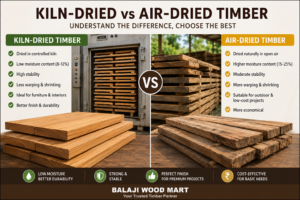
 Kiln-Dried vs Air-Dried Timber
When I help my customers choose timber, one of the most common questions I hear is, “Which is better—Kiln-Dried vs Air-Dried Timber?” I always explain that choosing the right timber is not just about price. It is about durability, stability, appearance, and long-term performance.
Understanding Kiln-Dried vs Air-Dried Timber helps me make better decisions for furniture, doors, windows, modular interiors, flooring, and construction projects. The wrong choice can lead to cracks, warping, shrinkage, or expensive repairs later.
In this guide, I will explain Kiln-Dried vs Air-Dried Timber in simple language so I can confidently select the right timber for every project.
What is Kiln-Dried Timber?
Kiln-dried timber is wood that has been dried inside a specially designed chamber called a kiln. The temperature, humidity, and airflow are carefully controlled to reduce the wood’s moisture content.
The drying process usually takes several days or weeks depending on the timber species and thickness.
I often recommend kiln-dried timber because it offers predictable performance and is ready for immediate use.
Benefits of Kiln-Dried Timber
-
Low moisture content
-
Excellent dimensional stability
-
Less shrinking
-
Less warping
-
Better strength
-
Reduced risk of fungal growth
-
Better finishing quality
-
Ideal for premium furniture
What is Air-Dried Timber?
Air-dried timber is naturally dried by stacking wood in open spaces where air circulates around it. The drying process depends on weather conditions and usually takes several months.
Since nature controls the drying process, moisture levels remain higher compared to kiln-dried timber.
I generally choose air-dried timber for projects where slight movement is acceptable.
Benefits of Air-Dried Timber
-
Lower processing cost
-
More economical
-
Suitable for outdoor structures
-
Traditional drying method
-
Lower energy consumption
Kiln-Dried vs Air-Dried Timber: Major Differences
Understanding Kiln-Dried vs Air-Dried Timber becomes easier when I compare them side by side.
| Feature | Kiln-Dried Timber | Air-Dried Timber |
|---|---|---|
| Drying Method | Controlled kiln | Natural air |
| Drying Time | Days or weeks | Months |
| Moisture Content | 8–12% | 15–25% |
| Stability | Very high | Moderate |
| Warping Risk | Very low | Higher |
| Shrinkage | Minimal | More likely |
| Furniture Quality | Excellent | Good |
| Finish Quality | Superior | Average |
| Indoor Projects | Best | Acceptable |
| Outdoor Projects | Suitable after treatment | Commonly used |
Why Moisture Content Matters
One of the biggest reasons I compare Kiln-Dried vs Air-Dried Timber is moisture content.
Timber naturally contains water. If too much moisture remains inside the wood, it continues drying after installation.
This can cause:
-
Cracks
-
Twisting
-
Bowing
-
Joint gaps
-
Surface splitting
-
Loose fittings
Kiln-dried timber reaches an ideal moisture level before installation, reducing these problems significantly.
Which Timber is Better for Furniture?
Whenever I manufacture premium furniture, I always prefer kiln-dried timber.
Furniture made from kiln-dried timber remains stable throughout the year even when temperature and humidity change.
It also accepts polish, veneer, laminate, and paint much better.
If I use air-dried timber for premium furniture, I may experience movement later, especially in indoor air-conditioned environments.
Which Timber is Better for Doors and Windows?
When selecting timber for doors and windows, I carefully consider exposure to weather.
Kiln-dried timber performs exceptionally well because it maintains its dimensions and reduces seasonal expansion.
This means:
-
Better door alignment
-
Smooth opening and closing
-
Fewer cracks
-
Better hardware fitting
Is Air-Dried Timber Ever a Better Choice?
Yes.
Although many people assume kiln-dried timber is always superior, I know that air-dried timber still has valuable applications.
I often recommend air-dried timber for:
-
Farm structures
-
Temporary construction
-
Outdoor fencing
-
Packaging
-
Low-budget projects
When cost is the highest priority, air-dried timber can be a practical option.
Cost Comparison
One important factor in Kiln-Dried vs Air-Dried Timber is pricing.
Kiln drying requires specialized equipment, energy, skilled monitoring, and quality control.
Because of this, kiln-dried timber costs more.
However, I always remind customers that cheaper timber may become expensive if it causes repairs, replacements, or furniture damage later.
Common Mistakes Buyers Make
Many buyers focus only on price.
I avoid making these mistakes:
-
Buying timber without checking moisture content
-
Ignoring storage conditions
-
Choosing air-dried timber for modular furniture
-
Not asking about seasoning
-
Purchasing from unreliable suppliers
-
Assuming all timber is equally dry
These mistakes often result in expensive maintenance.
How I Identify Good Quality Timber
Whenever I purchase timber, I inspect several important factors.
I check:
-
Moisture level
-
Straight grain
-
Uniform colour
-
Minimal knots
-
No fungal stains
-
No insect damage
-
Proper seasoning
-
Smooth surface
These simple checks help me select timber that performs well over time.
Which Timber Should I Choose?
When comparing Kiln-Dried vs Air-Dried Timber, my choice depends on the project.
I choose kiln-dried timber for:
-
Luxury furniture
-
Office furniture
-
Modular kitchens
-
Interior panels
-
Doors
-
Windows
-
Wardrobes
-
Hotel interiors
I choose air-dried timber for:
-
Outdoor applications
-
Budget projects
-
Temporary structures
-
Packaging
-
Agricultural use
Why I Trust Quality Timber Suppliers
Even the best drying process cannot compensate for poor-quality timber.
That is why I always purchase from trusted timber suppliers who maintain proper storage, quality inspection, and moisture control.
At Balaji Wood Mart, we understand that every project has unique requirements. We help customers choose the right timber based on application, durability, budget, and long-term performance. Whether you need kiln-dried timber for premium interiors or air-dried timber for economical projects, selecting the correct material is the first step toward a successful outcome.
Final Thoughts
Choosing between Kiln-Dried vs Air-Dried Timber is not simply about selecting one type over the other. It is about understanding where each performs best.
I have learned that investing in the right timber at the beginning saves money, improves durability, and ensures better results for years to come. By understanding moisture content, stability, finishing quality, and project requirements, I can confidently choose the right timber for every application.
What type of project are you planning, and which timber do you think will deliver the best long-term results for you?
Frequently Asked Questions (FAQs)
1. What is the main difference between Kiln-Dried vs Air-Dried Timber?
The biggest difference is moisture content. Kiln-dried timber is dried in a controlled chamber to achieve lower moisture levels, while air-dried timber dries naturally over several months.
2. Is kiln-dried timber better for furniture?
Yes. Kiln-dried timber is generally preferred for furniture because it offers greater stability, less shrinkage, and a smoother finish.
3. Why is kiln-dried timber more expensive?
Kiln drying requires specialized equipment, controlled conditions, energy, and quality monitoring, which increase production costs.
4. Can air-dried timber be used indoors?
Yes, but it is generally better suited to projects where slight movement is acceptable. For premium indoor furniture and interiors, kiln-dried timber is usually the better choice.
5. How can I check if timber is properly dried?
You can ask the supplier for the moisture content, inspect the timber for signs of warping or cracks, and purchase from a trusted timber supplier that follows proper seasoning and storage practices.
6. Which timber is best for doors and windows?
Kiln-dried timber is generally the preferred option because it is more dimensionally stable and less likely to warp or shrink over time.