
How to Identify Genuine Teak Wood
Focus Keyword: How to Identify Genuine Teak Wood
How to Identify Genuine Teak Wood: My Complete Buyer’s Guide
If I want to identify genuine teak wood, I know that I must look beyond appearance alone. Genuine teak wood is one of the most valuable hardwoods in the world because of its durability, strength, natural oils, and timeless beauty. However, I also know that the timber market is full of look-alike woods that are often sold as teak.
Whenever I help customers at Balaji Wood Mart, I believe that educating them is just as important as selling timber. That’s why I always explain how to identify genuine teak wood before making any purchase. By understanding a few simple checks, I can confidently choose the right timber for furniture, doors, windows, flooring, and premium interiors.
In this guide, I will share the practical methods that I personally recommend to identify genuine teak wood and avoid costly mistakes.
Why Genuine Teak Wood Is So Valuable
Before I learn how to identify genuine teak wood, I first understand why it is so highly valued.
Genuine teak offers:
Exceptional durability
Natural resistance to termites
High moisture resistance
Excellent dimensional stability
Long service life
Beautiful golden-brown appearance
Low maintenance requirements
These qualities make genuine teak wood a premium investment rather than just another type of timber.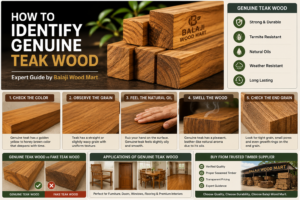
1. Check the Natural Color
The first thing I observe while trying to identify genuine teak wood is its natural color.
Fresh teak usually has:
Golden yellow shade
Honey brown appearance
Rich golden brown after seasoning
Uniform grain with slight natural variation
I stay cautious if the wood looks unnaturally dark or has an artificial coating that hides the grain.
2. Observe the Grain Pattern Carefully
A simple way to identify genuine teak wood is by studying its grain.
Real teak generally has:
Straight grain
Slightly wavy grain in some logs
Smooth texture
Even grain pattern
Natural elegance
If I notice irregular patches, excessive knots, or inconsistent grain, I inspect the timber more carefully.
3. Feel the Natural Oil
One of the easiest ways I use to identify genuine teak wood is by touching the surface.
Genuine teak contains natural oils that make it feel:
Smooth
Slightly oily
Dense
Premium to the touch
These natural oils are also the reason teak survives for decades without significant damage.
4. Check the Weight
Many buyers assume heavier wood is always better.
When I identify genuine teak wood, I know that teak has moderate density. It feels solid without being excessively heavy.
If a wood piece feels unusually light or extremely heavy, I always investigate further because it may be another hardwood being sold as teak.
5. Smell the Timber
This is one of my favorite methods to identify genuine teak wood.
Fresh teak has a pleasant leather-like or natural woody smell because of its oils.
Cheap substitutes usually have:
Little to no aroma
Chemical smell
Artificial polish odor
The natural fragrance often helps experienced timber buyers identify genuine teak quickly.
6. Inspect the End Grain
Whenever I purchase premium timber, I carefully inspect the cross-section.
To identify genuine teak wood, I look for:
Tight grain
Uniform texture
Even growth rings
Small pores
This simple inspection reveals a lot about the wood’s authenticity.
7. Ask About the Origin
The source of timber matters.
When I want to identify genuine teak wood, I always ask where it comes from.
Common sources include:
Burma Teak
African Teak
Indian Teak
Ghana Teak
Central American Teak
A trustworthy timber supplier should always provide accurate information about the timber’s origin.
8. Verify Moisture Content
Good teak should be properly seasoned.
Before buying, I check whether the timber has appropriate moisture content.
Properly seasoned teak:
Lasts longer
Cracks less
Resists warping
Performs better in furniture manufacturing
9. Look for Natural Termite Resistance
Another practical way to identify genuine teak wood is by understanding its natural durability.
Real teak naturally contains oils that help resist:
Termites
Borers
Moisture
Decay
Although no wood is completely termite-proof under every condition, genuine teak performs significantly better than many alternatives.
10. Buy Only From Trusted Timber Suppliers
No matter how much I know about how to identify genuine teak wood, choosing a reliable supplier remains the most important decision.
At Balaji Wood Mart, I always believe customers deserve:
Honest guidance
Transparent pricing
Premium quality timber
Proper product information
Reliable customer support
Buying from an experienced timber trader reduces the chances of receiving inferior or misrepresented wood.
Common Mistakes I Avoid While Buying Teak Wood
Whenever I purchase teak, I avoid these common mistakes:
Choosing only based on price
Ignoring the grain pattern
Not checking seasoning quality
Trusting polished surfaces alone
Forgetting to ask about timber origin
Buying without inspecting the wood personally
Selecting unknown suppliers
Avoiding these mistakes helps me invest in timber that delivers value for decades.
Why I Trust Genuine Teak Wood
I always recommend genuine teak because it offers long-term benefits that cheaper alternatives cannot match.
Some of my favorite advantages include:
Elegant appearance
Long lifespan
Better resale value
Excellent weather resistance
Premium finish
Lower maintenance
Superior durability
For furniture, doors, windows, luxury interiors, and architectural projects, genuine teak continues to be one of the smartest investments.
Conclusion
Now that I understand how to identify genuine teak wood, I can make informed decisions instead of relying solely on a seller’s claims. I know that checking the grain, natural oils, weight, aroma, seasoning, and timber source helps me avoid costly mistakes and ensures I receive authentic, high-quality timber.
At Balaji Wood Mart, I believe every customer deserves genuine guidance along with genuine timber. My goal is to help buyers invest confidently in wood that delivers beauty, strength, and lasting performance for years to come.
Which method will you use first to identify genuine teak wood before making your next timber purchase?
Frequently Asked Questions (FAQs)
1. How can I identify genuine teak wood at home?
I check the grain pattern, natural oil, weight, color, aroma, and texture. These characteristics usually help me identify genuine teak wood.
2. Does genuine teak wood have a natural smell?
Yes. Genuine teak wood often has a pleasant, leather-like woody aroma because of its natural oils.
3. Is genuine teak wood termite-proof?
Genuine teak wood has excellent natural resistance to termites because of its oil content, although no wood is completely immune under every condition.
4. Which teak wood is considered the best?
The best choice depends on the application, but Burma Teak is widely regarded as one of the highest-quality teak varieties due to its durability and appearance.
5. Why should I buy teak wood from a trusted timber supplier?
A trusted supplier provides authentic timber, transparent information about origin and quality, proper seasoning, and reliable after-sales support, reducing the risk of buying imitation products.